What Is Progressive Overload? The Complete Guide to Building Muscle and Strength
If you want to build muscle and strength over time, your training must continue to challenge your body.
This concept is known as progressive overload.
Progressive overload refers to gradually increasing the training stimulus over time so your body continues to adapt. Without it, progress eventually slows or stops.
In simple terms, if your workouts never become more challenging, your body has no reason to keep building muscle or getting stronger.
In this guide, you’ll learn:
- What progressive overload actually means
- What progressive overload is not
- How progressive overload drives muscle growth
- The best ways to apply it in your workouts
- How quickly progress should occur
- Common mistakes to avoid
What Is Progressive Overload?
Progressive overload occurs when your training stimulus is challenging enough to force your body to adapt.
If you repeatedly train with the same weight, the same number of reps, and the same effort level, your body eventually adapts to that workload. Once that happens, progress slows or stops.
To continue building muscle and strength, the demands placed on your muscles must gradually increase over time.
When you train hard, your muscles experience stress. If you recover properly, your body responds by adapting so it can better handle that stress in the future.
These adaptations include:
- Increased muscle size
- Increased strength
- Improved neuromuscular efficiency
A larger muscle contains more contractile tissue, which contributes to force production. That’s why, in most cases, a bigger muscle is also a stronger muscle.
Why Progressive Overload Is Important for Muscle Growth
Your job in the gym is to create a strong muscle-building stimulus.
Exercises are simply tools for the job.
Use those tools well by:
- Using good technique
- Training with high effort
- Managing fatigue
- Recovering properly
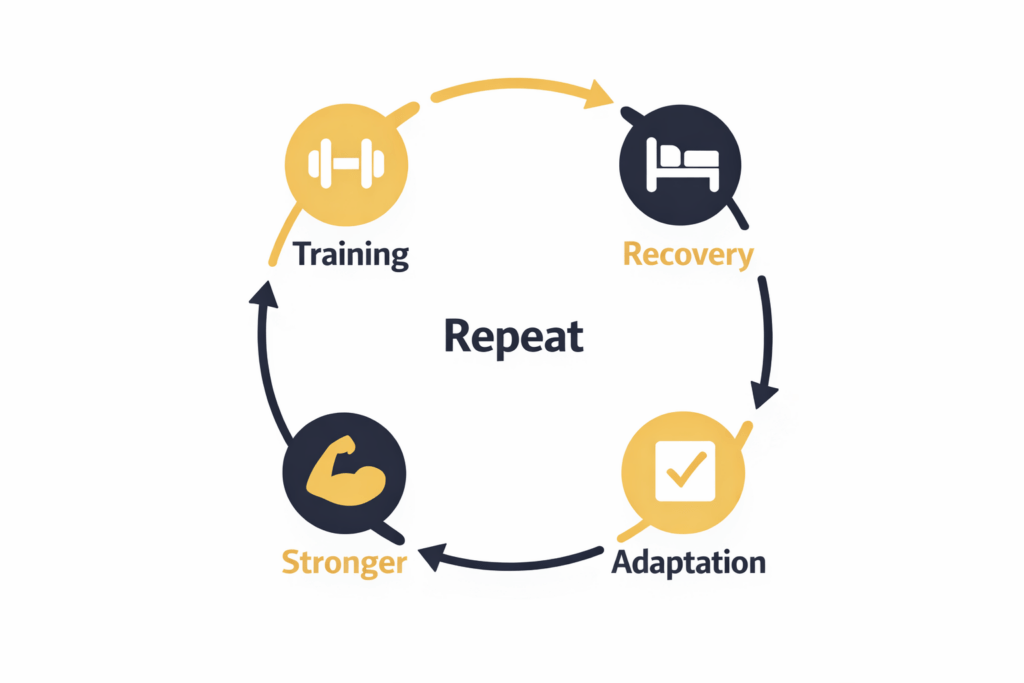
If the stimulus is sufficient and you recover well, your muscles adapt by becoming larger and stronger.
As a result, over time you’ll be able to:
- Lift more weight for the same reps
- Perform more reps with the same weight
These improvements signal that your body has adapted to your training.
To continue building muscle, you must then increase the demand again.
This cycle is the foundation of progressive overload:
Progressive Overload vs Progressive Tension Overload
Progressive overload is often described as simply adding more weight or performing more reps over time.
While those are the most common ways progress shows up, what actually drives muscle growth is an increase in mechanical tension placed on the muscle fibers.
In other words, the goal of progressive training is not just doing more work—it’s creating greater muscular tension over time.
For example, the stimulus placed on a muscle can increase when you:
- Improve exercise technique
- Train closer to muscular failure
- Use a larger range of motion
- Choose exercises that place more tension on the muscle
All of these can increase the quality of the training stimulus even if the weight on the bar hasn’t changed yet.
Over time, these improvements typically allow you to lift heavier weights or perform more reps.
But the underlying driver of adaptation is the progressive increase in muscular tension.
What Progressive Overload Is NOT
Many people misunderstand progressive overload.
They assume it means adding more weight every workout.
But progressive overload is not something you simply choose to do. It is the result of your body adapting to training.
There are many ways to increase the training stimulus, such as:
- Improving exercise technique
- Increasing range of motion
- Training closer to failure
- Performing more sets
- Choosing exercises that place more tension on a muscle
These changes can all increase the training stimulus.
However, they are choices you can make anytime you walk into the gym. They do not necessarily indicate that your body has adapted.
The clearest signs of progress are when you can:
- Lift more weight
- Perform more reps with the same weight
These improvements cannot simply be chosen.
If they could, you could decide to add weight every week and eventually be lifting thousands of pounds for high reps.
That doesn’t happen.
The ability to lift more weight or perform more reps occurs only after your body adapts to the training stimulus.
The Best Ways to Increase the Training Stimulus
While progressive overload ultimately shows up as increases in weight or reps, several strategies can increase the training stimulus that leads to those improvements.
Increase Weight
The most obvious form of progressive overload is gradually increasing the weight you lift.
If you can lift more weight for the same number of reps while maintaining good technique, your muscles have clearly adapted.
Increase Reps
Another effective strategy is performing more reps with the same weight before increasing the load.
For example:
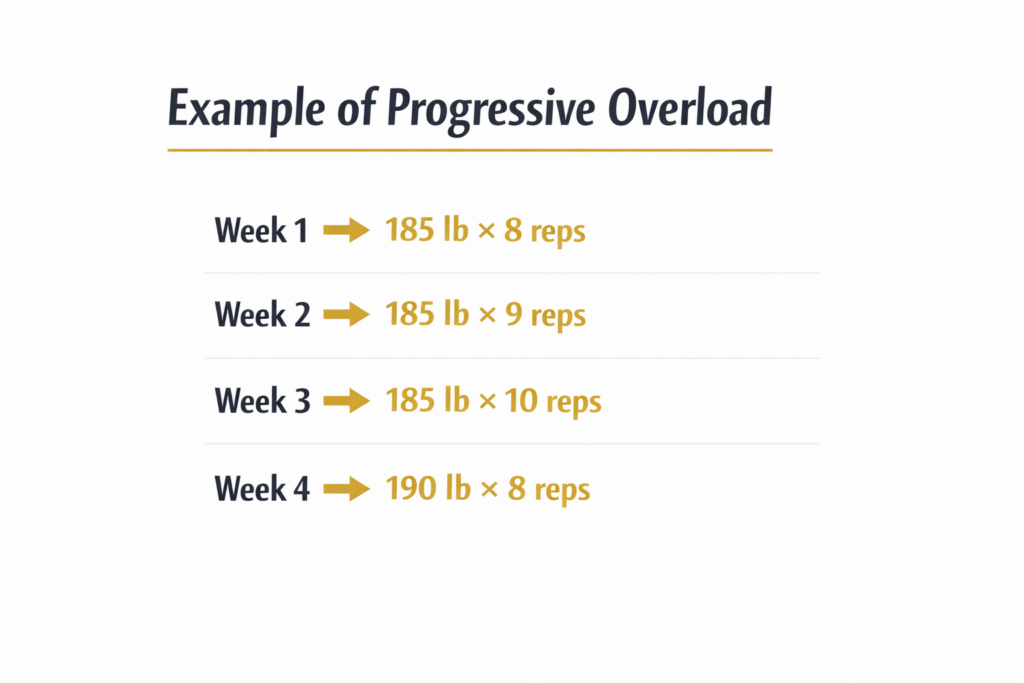
Week 1: 185 x 8
Week 2: 185 x 9
Week 3: 185 10
That improvement indicates progress.
Increase Training Volume
Adding additional sets increases the total workload placed on a muscle.
For example, moving from two sets of an exercise to three or four sets increases the total stimulus.
This often becomes more important as lifters gain experience.
Train Closer to Failure
Two sets with the same weight and reps can produce very different levels of stimulus depending on how close they are to muscular failure.
For example:
10 reps with 4 reps in reserve
10 reps with 1 rep in reserve
The second set creates significantly more muscular tension and fiber recruitment.
Increase Training Frequency
Training a muscle more often each week can increase the total stimulus while keeping fatigue manageable.
For example:
Instead of performing 12 sets for chest in one session, you might perform:
6 sets on Monday
6 sets on Thursday
This often improves performance and recovery.
Improve Technique
Better technique increases tension on the target muscle and improves the quality of the training stimulus.
As lifters gain experience, they usually become better at controlling movements and directing tension into the intended muscle.
Increase Range of Motion
Using a fuller range of motion can place greater tension on muscles.
For example, lowering deeper during a dumbbell press or performing a squat through a full range of motion can increase stimulus compared to partial reps.
Improve Exercise Selection
Some exercises simply place better tension on certain muscles.
For example:
A chest-supported row may allow better back stimulation than a barbell row for some lifters.
Choosing exercises that match your structure and allow strong tension can significantly improve the effectiveness of your training.
Over time, these improvements should eventually allow you to lift heavier weights or perform more reps, which signals true adaptation.
How Fast Should Progressive Overload Occur?
One of the biggest misconceptions about progressive overload is that progress should happen every week.
In reality, the speed of progress depends on several factors:
- Training experience
- Exercise selection
- Recovery
- Genetics
- Nutrition
Beginners often progress quickly because their bodies are highly responsive to training.
More experienced lifters progress more slowly.
Different exercises also progress at different speeds.
For example:
Squats and deadlifts often increase relatively quickly, while smaller isolation exercises like lateral raises progress more slowly.
As you become more advanced, increases in weight or reps may occur every few weeks or even every few months.
Progressive overload should be viewed as a long-term trend, not something that must occur every workout.
Why Technique Improvements Sometimes Reduce the Weight
As your training experience increases, your technique typically improves.
Better technique often comes with better control and ability to drive tension to the target muscle group.
Sometimes this requires temporarily reducing the weight.
For example, you might decrease the weight by 10–20 pounds so you can perform the movement with better form.
Then you gradually build the weight back up.
If you eventually reach your previous weight and reps with better technique, it’s very likely you’ve built more muscle—even though the numbers are the same.
Why Tracking Your Workouts Is Essential
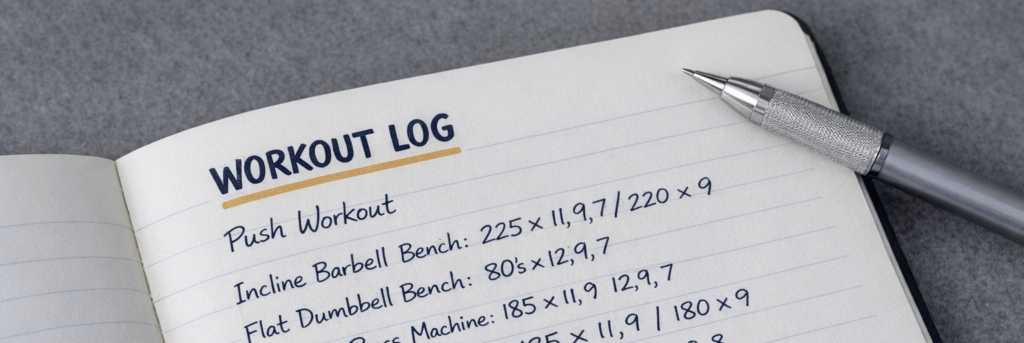
Because progressive overload relies on measurable improvements, tracking your workouts is extremely important.
Without tracking your training, it’s difficult to know whether you’re actually progressing.
Record things like:
- Exercises performed
- Sets
- Reps
- Weight lifted
Over time, these numbers should gradually trend upward.
If you increase your bench press from 150 pounds for 8 reps to 250 pounds for 12 reps, you can be confident you’ve built significant muscle.
Strength improvements like that require physical adaptation.
Common Progressive Overload Mistakes
Even though progressive overload is simple in theory, many lifters apply it incorrectly.
Here are some of the most common mistakes.
Increasing Weight Too Quickly
Many lifters believe progressive overload means adding weight every workout.
While this can happen early in training, progress slows over time.
More often, progression looks like:
- Performing more reps
- Improving technique
- Training closer to failure
Eventually those improvements allow weight increases.
Sacrificing Technique to Lift More Weight
Adding weight only counts as progress if the target muscles are still doing the work.
Many lifters increase weight but begin using excessive momentum, shortening range of motion, or shifting the load to other muscles.
This often reduces the stimulus on the intended muscle.
Ignoring Recovery and Fatigue
Progressive overload doesn’t mean constantly pushing harder without limits.
Your body must recover to adapt.
If training stress increases faster than your ability to recover, performance often stalls or declines.
Signs this may be happening include:
- Strength decreasing
- Persistent fatigue
- Reduced motivation to train
Progressive overload works best when increases in training demand are gradual and sustainable.
Practical Training Guidelines for Progressive Overload
Here are some practical guidelines to help ensure progressive overload is happening in your training.
Choose Effective Exercises
Select exercises that allow you to place high tension on the target muscle group.
Keep Exercises Consistent
Consistency allows you to track progress from week to week.
Train Close to Failure
Most sets should end within 0–3 reps of failure to provide a strong growth stimulus.
Use Moderate Rep Ranges
For muscle growth, most training should fall between 5–20 reps per set.
Train Each Muscle Enough
Aim for roughly 10–20 challenging sets per muscle group per week.
Log Your Workouts
Track your exercises, sets, reps, and weights so you can gradually improve them over time.
Prioritize Recovery
Muscle growth occurs during recovery, not just during workouts.
Focus on:
- Getting enough sleep
- Eating enough calories and protein
- Managing stress
In my experience coaching clients, the people who consistently track their workouts and focus on progressive overload are almost always the ones who make the most progress.
How to Apply Progressive Overload (Step-by-Step)
If you want to apply progressive overload in your training, follow this simple process.
Step 1: Choose a controllable weight
Select a weight you can lift within your target rep range using good technique.
For example, if your goal is 8–12 reps, choose a weight you can lift for at least 8 quality reps.
Step 2: Train close to failure
To stimulate muscle growth, most sets should end within 0–3 reps of failure.
Step 3: Add reps first
Before increasing weight, try to increase the number of reps you perform with the same weight.
Example progression:
Week 1: 185 × 8
Week 2: 185 × 9
Week 3: 185 × 10
Step 4: Increase the weight
Once you reach the top of your rep range, increase the weight slightly.
Example:
185 × 12 → increase to 190 pounds
Your reps will likely drop again, and you repeat the process.
Step 5: Repeat the process
Continue gradually improving your lifts by adding reps or weight whenever possible.
Over time, these small improvements add up to significant strength and muscle gains.
Frequently Asked Questions About Progressive Overload
What is an example of progressive overload?
An example of progressive overload would be increasing your bench press from 185 pounds for 8 reps to 185 pounds for 10 reps, or eventually increasing the weight to 195 pounds for 8 reps.
Both represent an increase in training demand.
How often should you increase weight?
There is no fixed timeline.
Beginners may increase weight weekly, while more advanced lifters might only increase weight every few weeks or months depending on the exercise.
Can you build muscle without progressive overload?
Muscle growth requires progressive overload over time. If your training stimulus never increases, your body will eventually adapt and muscle growth will slow or stop.
Is progressive overload only about lifting heavier weights?
No. Progressive overload can occur through increases in reps, training volume, range of motion, or exercise quality. However, these improvements should eventually lead to increases in strength over time.
Is progressive overload necessary for beginners?
Yes. Progressive overload is important for beginners and advanced lifters alike. Beginners often progress quickly because their bodies adapt rapidly to new training stimuli.
| If you’re working toward building muscle or improving your physique and want guidance along the way, I offer online coaching.
You can learn more about working together here: Online Personal Training & Nutrition Coaching |
Conclusion
Progressive overload simply means gradually increasing the demands placed on your muscles over time.
If you consistently:
- Train hard
- Recover well
- Track your workouts
- Gradually increase weight or reps
your body will adapt.
Those adaptations show up as more strength and more muscle.
Stay consistent long enough, and the results will follow.